Saturday, March 30, 2019

HCC zooms 8% on board approval for monetisation of specified awards & claims

Hindustan Construction Company shares rallied 8 percent intraday March 26 after the board approved monetisation of specified awards and claims.

The stock was quoting at Rs 15.34, up Rs 1.00, or 6.97 percent on the BSE, at 1424 hours IST.

HCC, on March 26, signed terms with a consortium of investors led by BlackRock, which will seek to monetise an identified pool of arbitration awards and claims for a consideration of Rs 1,750 crore.

The proposed transaction was approved by the board of directors of the company at its meeting held on March 26, 2019, and is subject to requisite approvals.

Under the terms of the transaction, HCC said it would transfer its beneficial interest and rights in an identified portfolio of arbitration awards and claims to a special purpose vehicle (SPV) controlled by a consortium of investors, including BlackRock.

HCC said it will utilise the amount to prepay debt of Rs 1,250 crore, including its entire term loan of Rs 942 crore that is due in the next 3 years and Rs 308 crore of OCDs.

The balance Rs 500 crore will be made available to fund working capital and business growth, it added.

  First Published on Mar 26, 2019 03:05 pm

Friday, March 29, 2019

Fed hints at no rate hike in 2019; move positive for Indian equities


Highlights:
- Fed scales back its policy rate projection; implies no rate hike in 2019
- Balance sheet unwinding to halt by September
- The decision weighs on the US Dollar Index and 10-year yield
- Accommodative Fed positive for emerging markets, especially Indian equities
-------------------------------------------------

The US Federal Reserve at its March meeting said it would be patient in changing policy rates. The move comes in the backdrop of global economic concerns and muted inflationary pressures.

More importantly, it has given a temporal definition of patience. Financial projections suggest that there would not be a rate hike this year. Further, balance sheet unwinding would halt by September, after the process itself slows down from May.

Chairman Jerome Powell stipulated that the Fed policy rate is already in neutral rate range i.e. policy rate is at level where it neither stimulates nor restrains economic growth by changing its interest rate policy.

related news Mindtree board to meet again on March 26 IL&FS Transportation Networks defaults on NCD payments due to insufficient funds Tata Steel to offer partial EU packaging sale for Thyssenkrupp deal approval: Sources

Also read: Indian equities get wings as global central banks shift track

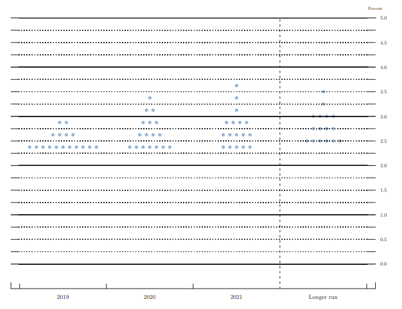
March - Dot plot

Compared to December 2018, there has been a sharp downward shift in the projections for the Federal funds rate. Policy rate projection for 2019 is now 2.4 percent (current policy rate range: 2.25-2.5 percent), which is a 50 bps (100 bps=1 percentage point) downward shift in three months. Simply put, this implies there is no rate hike expectation this year. The median expectation for 2020 and 2021 stands at 2.6 percent, which implies a solo rate hike in this interest rate cycle.

Federal Reserve Dot plot
Capture1

Source: Federal Reserve

Interestingly, at its December meeting, two out of 17 members had projected no rate hike in 2019. Now, 11 members anticipate no rate hike.

Tweaks in growth and inflation projections

The central bank observes that economic activity has slowed from Q4 CY18 in terms of growth moderation in household spending and business fixed investment in Q1 CY19. GDP growth for 2019 is expected to be 2.1 percent as against 2.3 percent earlier. Having said that, the labour market remains strong.

Headline inflation has declined largely on account of lower energy prices. However, inflation numbers excluding food and energy remains near its targeted level of two percent.

Balance sheet unwinding to halt

Interestingly, there has been increasing deliberation around its stance of balance sheet unwinding for at least the last three meetings. With this meeting, its stance has officially changed from an autopilot unwinding of the balance sheet to one where it would halt by September. This means the Fed would keep its balance sheet size at elevated levels compared to earlier monetary policy cycles. By revising the unwinding run-rate, it expects its balance sheet to stabilise around $3.7 trillion.

Total assets with the Federal Reserve

CaptureSource: fred.stlouisfed.org

Implications

One, the downward shift in policy rate expectation should not be seen as a sudden measure. The Fed had given enough indications of that happening though their qualitative assessments and commentary in the last three months.

Two, lower domestic growth expectation is also a reflection of lesser growth estimations from other parts of the world, especially eurozone and China. It's noteworthy that the International Monetary Fund (IMF) downgraded its global growth forecast earlier this year, followed by weaker regional growth assessments by European Central Bank (ECB) and China.

Third, it means that the 'pause' in the rate hike cycle has now a temporal definition – the rate hike may not happen in 2019.

The moot question is – does the market as well think so? CME Fedwatch tool indicates that the probability for a rate cut in 2019 has increased to 29 percent from 14 percent a month before. Powell statement -- "The data are not currently sending a signal that we need to move in one direction or another " -- doesn't rule out this possibility.

Nevertheless, the scenario of "growth moderation, but an accommodative central banks" continues to be positive for emerging markets. The Dollar Index has slumped after the Fed announcement. The US 10-year yield has broken important support levels and is in a range last witnessed in December 2017.

We may witness extension of the current phase of carry trade, wherein countries like India benefit. This implies relatively stable growth versus other parts of the world like eurozone and China.

Having said that, investors should continue to keep a close watch on developments in China, US-China trade talks and Brexit. If any one of these factors worsen, it can interrupt the recent EM fund flow party.

Follow @anubhavsays

For more research articles, visit our Moneycontrol Research page First Published on Mar 21, 2019 10:13 am

Saturday, March 23, 2019

Buy Electronic Arts To Play The Video Gaming Game

&l;p&g;For public video game makers, 2018 was the worst of times. Industry executives were blindsided by &q;Fortnite,&q; a free-to-play phenomenon from Epic Games.

&l;strong&g;Electronic Arts&l;/strong&g; saw its shares get cut in half from their 2018 highs, although those have rebounded this year.

&l;img class=&q;dam-image ap size-large wp-image-18be38d459de4e50961d14509aa8884a&q; src=&q;https://specials-images.forbesimg.com/dam/imageserve/18be38d459de4e50961d14509aa8884a/960x0.jpg?fit=scale&q; data-height=&q;640&q; data-width=&q;960&q;&g; In this Wednesday, March 6, 2019, photo a gamer plays Electronic Arts&s; &q;Apex Legends&q; in Jersey City, N.J. (AP Photo/Jenny Kane)

The stock is a buy at current levels. Let me explain why.

It&s;s important to remember that, beneath all the mystery in the mainstream about games and gaming culture, the industry functions much like the Hollywood studio system.

Like feature films, games are pitched and financed. They are meticulously produced and promoted. The goal is to create engrossing narratives and lasting franchises.

&q;Madden Football,&q; an EA Sports game that mirrors the NFL, debuted in 1988. It&s;s now a vibrant ecosystem. It even spawned a&a;nbsp;&l;a href=&q;http://em.weisspublishinginc.com/hH77S0U00N000dvD3030N5n&q; target=&q;_blank&q; rel=&q;noopener noreferrer&q; target=&q;_blank&q;&g;professional gaming league&l;/a&g;, where eSport athletes compete for six-figure prize money.

Wall Street analysts think &q;Fortnite&q; has the potential to be bigger. Set in a post-apocalyptic world, the cross-platform battle royale has players band together in groups of four to rebuild the homeland with elaborate forts.

They fend off monsters with exotic imaginary weapons, that players buy while the game is underway. The $2.4 billion the company raked in during 2018 via these virtual trinket sales made &q;Fortnite&q; the top free-to-play game by revenue.

According to a&a;nbsp;&l;em&g;Business Insider&l;/em&g;&a;nbsp;&l;a href=&q;http://em.weisspublishinginc.com/I070TNn0H0763v3d0D0UN00&q; target=&q;_blank&q; rel=&q;noopener noreferrer&q; target=&q;_blank&q;&g;story&l;/a&g;, registered players topped 200 million in December 2018, up from 75 million members in June. And 60% of players were in the key 18- to 24-year-old demographic.

The problem is young people get bored easily.&a;nbsp;They move on. And there are some signs of &q;Fortnite&q; fatigue.

Epic Games staged an&a;nbsp;&l;a href=&q;http://em.weisspublishinginc.com/y7DNnd730v0HNUU00700030&q; target=&q;_blank&q; rel=&q;noopener noreferrer&q; target=&q;_blank&q;&g;in-game concert&a;nbsp;&l;/a&g;earlier in February with Marshmello, a popular electronic music DJ. Last week,&a;nbsp;Variety&a;nbsp;&l;a href=&q;http://em.weisspublishinginc.com/O0D070dN03003NHV080v7nU&q; target=&q;_blank&q; rel=&q;noopener noreferrer&q; target=&q;_blank&q;&g;reported&l;/a&g;&a;nbsp;the company plans to offer $100 million competitive prize pool money during 2019.

These moves come against the backdrop of escalating competition.

Electronic Arts released &q;Apex Legends&q; on Feb. 4. Only three days later, this free-to-play battle royale&a;nbsp;&l;a href=&q;http://em.weisspublishinginc.com/jd9U073HN000n073NvW0D00&q; target=&q;_blank&q; rel=&q;noopener noreferrer&q; target=&q;_blank&q;&g;reached 10 million players&l;/a&g;. By the end of the first week, the number of players jumped to 25 million.

I&s;m not claiming &q;Apex Legends&q; will be the next &q;Fortnite.&q; As fast as the franchise has grown, it is still a newcomer.

The more compelling story is about sentiment &a;hellip;

Video game stocks got walloped in 2018 because investors bet &q;Fortnite&q; might be a multiyear story, a la &q;Madden&q; or&a;nbsp;&l;strong&g;Activision Blizzard&s;s&l;/strong&g;&a;nbsp; &q;Call of Duty.&q; Any data that shatters this perception will lead to a revaluation of the entire sector.

Electronic Arts is especially attractive because it owns Apex Legends.

Gaming is a great business.&a;nbsp;The industry grew 10% to $116 billion in sales during 2018.

That was more than TV ($105 billion), Film Box Office ($41 billion) and Digital Music ($17 billion).

Electronic Arts shares trade at 24x forward earnings. The market capitalization is $28.7 billion.

The company is the second-largest gaming franchise in the world. The opportunity for investors is that video game stocks will likely return to favor.

Given the industry is the fastest growing media segment, it is a good bet.&a;nbsp;My target is $200 by the end of 2022.&l;/p&g;

Wednesday, March 20, 2019

Here's how to navigate the booming business of college advisors

Helping kids get into college is a big business — and it's growing fast.

The industry gained some unwelcome notoriety early this week when dozens of people — including actresses Felicity Huffman and Lori Loughlin — were arrested in an admissions bribery scheme.

The person behind it was William "Rick" Singer, founder of the Edge College & Career Network. He pleaded guilty to a number of charges, including racketeering, for masterminding the scheme, which included bribing college athletic coaches and having other people take admissions tests for the children of those who hired him.

Members of the profession swiftly condemned Singer's actions and pointed out that the charges exemplified the concern parents feel about getting their children into the right college.

"We know anxiety is off the charts. Part of the reason anxiety is off the charts is the decision-making in colleges has become so opaque," said Mark Sklarow, CEO of the Independent Educational Consultants Association. "We see that parents are willing to do just about anything."

His organization, a nonprofit that represents independent educational consultants, estimates there are about 8,000 people in the profession full-time, as well as thousands more who "dabble" in it.

The IECA has about 2,000 members — double the number from five years ago — who are required to abide by a code of conduct.

What you get for your money

The purpose of a college consultant is to help parents and their children navigate the application process, prepare for entrance exams and choose the right college — and it can cost a lot of money. The average hourly fee in 2018 was $200, according to the IECA. Comprehensive package costs range from $850 to $10,000.

Chris Rim, founder and chairman of Command Education, told CNBC on Friday he creates a yearlong road map for students that includes their objectives and what they need to do to stay on track. His fees start at $950 an hour.

"Because admission rates are so low, you can't just have ... straight As, perfect or near-perfect SAT or ACT scores. You are going to need something that makes you stand out," he said on "Power Lunch."

A view of people visiting the University of Southern California on March 12, 2019 in Los Angeles, California. Federal prosecutors say their investigation dubbed Operation Varsity Blues blows the lid off an audacious college admissions fraud scheme aimed at getting the children of the rich and powerful into elite universities. Allen J. Schaben | Los Angeles Times | Getty Images A view of people visiting the University of Southern California on March 12, 2019 in Los Angeles, California. Federal prosecutors say their investigation dubbed Operation Varsity Blues blows the lid off an audacious college admissions fraud scheme aimed at getting the children of the rich and powerful into elite universities.

Colleges want someone with a singular focus, not a well-rounded student, Rim said. "They want students who know what they want to do," not someone who is the president of six clubs, he added.

Private college counselor Sara Harberson touts her experience as the former associate dean of admissions at the University of Pennsylvania and the former dean of admissions at Franklin and Marshall College. She also worked as a director of college counseling at the Baldwin School in Pennsylvania.

"I teach them how to think like admissions officers. That's what parents want. They want to get the inside scoop," she said on "Power Lunch."

It's also more than just helping prep for entrance exams or filling out applications.

"If they do it right, they understand kids. They understand teenagers and really what is the very best essence of who that student is. Most students in high school, they do what everyone else does," added Harberson. Her rates go up to $600 an hour, but she said she also does free work and provides consulting at a low monthly cost.

How to find the right advisor

The first thing to figure out is if you even need one, said the IECA's Sklarow.

"If you are at a school that has a low student-to-counselor ratio, you may get all the help you need in a school setting," he explained.

Students who know they have to attend a state university or are only choosing between a couple of schools likely don't need to hire an advisor either.

The next step is to decide if you need a few hours of consultation to get headed in the right direction or if you need a full package of service, said Sklarow.

""Unless states are going to infuse and overhaul their college counseling programs at high schools, parents are going to want this. They are going to need it — all income levels." -Sara Harberson, Private college counselor

When checking out potential consultants, parents should look at the messaging on their website and pay attention to what is said in the first "get-to-know-you meeting," Sklarow said. If it is all about getting into college, that's a short-term outcome. If it is about finding the right place where the student is going to thrive, that benefit lasts a lifetime, he said.

On top of that, check out the consultant's credentials. He suggests parents look for someone who has a background in counseling and find out how many colleges the person goes to each year. Ideally, it would be someone who spends one-third of the time on the road visiting campuses.

"So much of that match is to really understand the college socially, educationally and other ways," said Sklarow.

He also said it's important to make sure the person is vetted and is a member of a national organization that has already done a background check.

Scandal aftermath

While those in the industry "held their breath" after news broke about the admissions scandal, it now looks like it ultimately is starting to improve the profession, Sklarow said.

He's seen a spike in membership at the IECA over the last few days.

"Maybe in some ways this is going to lead to an industry that looks inwardly and finds a way to even improve on what we've been doing," he said.

Rim said he's already seen an increase in interest from potential clients. "Our phones have been ringing off the hook."

He thinks part of it is that parents "didn't know how competitive this process was. Just because you have perfect scores does not mean you are going to get in."

And it is something that isn't going to change — at least for now, said Harberson.

"Unless states are going to infuse and overhaul their college counseling programs at high schools, parents are going to want this," she said. "They are going to need it — all income levels."

More from Personal Finance
This professor just had $60,000 in student debt canceled
Wealthy parents in college admissions scam may face IRS wrath
Do this one thing now to feel more confident about your financial future

Wednesday, March 13, 2019

Spotify Makes Antitrust Complaint Against Apple -- Again

Swedish music-streaming leader Spotify (NYSE:SPOT) is tired of paying the Apple (NASDAQ:AAPL) tax. Spotify has now officially filed a complaint with the European Commission, alleging anticompetitive behavior stemming from Apple's dual role in operating one of the largest mobile platforms on Earth while also competing with third-party developers within the same platform. The news comes over a year after Spotify was reportedly seeking assistance from European regulators back in December 2017, and nearly four years after the U.S. Federal Trade Commission started to look at the situation (the FTC has yet to take any action).

This isn't the first time that Spotify has made its case, and it likely won't be the last.

Daniel Ek speaking on stage

Daniel Ek. Image source: Spotify.

What Spotify is asking for

In a blog post, Spotify founder and CEO Daniel Ek explained why his company has taken formal action against Apple after "careful consideration." Ek argues that the Mac maker has implemented rules in recent years that "purposely limit choice and stifle innovation." Spotify has unsuccessfully attempted to address its conflict with Apple to no avail, so it's now taking its case to regulators.

"Apple is both the owner of the iOS platform and the App Store -- and a competitor to services like Spotify," Ek writes. "In theory, this is fine. But in Apple's case, they continue to give themselves an unfair advantage at every turn."

In order to cope with paying Apple's 30% tax, Spotify has to either absorb the hit to its already-thin margins or pass along the tax to consumers in the form of higher prices. The latter scenario makes Spotify Premium less competitive with Apple Music's pricing. Neither is ideal. If Spotify chooses not to offer in-app subscriptions at all, then Apple "applies a series of technical and experience-limiting restrictions on Spotify," according to Ek. For example, Spotify can't even email customers outside of the app, since Apple owns and tightly controls the customer relationship.

Ek lays out three things Spotify is seeking: All apps should be subject to the same rules and restrictions, including Apple Music; consumers should be free to use any payment system they wish; and platform operators should not be able to restrict communications between third-party developers and users.

Spotify has a sympathetic ally

This all comes as U.S. Senator Elizabeth Warren has recently proposed breaking up numerous tech giants, including Apple. Warren has specifically argued that Apple should not be allowed to compete on the platform that it owns and operates due to anticompetitive effects. In a recent interview with The Verge, she said:

Apple, you've got to break it apart from their App Store. It's got to be one or the other. Either they run the platform or they play in the store. They don't get to do both at the same time.

The lawmaker's specific proposal would designate any tech companies with annual global revenue of $25 billion or more as "platform utilities," and such companies would be barred from owning the platform while simultaneously participating on said platform. With revenue of over $260 billion in 2018, Apple is far above that threshold.

Tuesday, March 12, 2019

Zacks: Brokerages Expect Affiliated Managers Group, Inc. (AMG) Will Post Quarterly Sales of $530.91

Brokerages expect Affiliated Managers Group, Inc. (NYSE:AMG) to post $530.91 million in sales for the current quarter, according to Zacks. Three analysts have provided estimates for Affiliated Managers Group’s earnings, with estimates ranging from $514.12 million to $553.60 million. Affiliated Managers Group reported sales of $612.40 million in the same quarter last year, which indicates a negative year over year growth rate of 13.3%. The business is expected to announce its next quarterly earnings results on Monday, April 29th.

According to Zacks, analysts expect that Affiliated Managers Group will report full year sales of $2.19 billion for the current financial year, with estimates ranging from $2.14 billion to $2.23 billion. For the next financial year, analysts anticipate that the business will report sales of $2.30 billion, with estimates ranging from $2.29 billion to $2.32 billion. Zacks Investment Research’s sales calculations are an average based on a survey of research firms that cover Affiliated Managers Group.

Get Affiliated Managers Group alerts:

Affiliated Managers Group (NYSE:AMG) last issued its earnings results on Monday, February 4th. The asset manager reported $3.53 earnings per share (EPS) for the quarter, beating the consensus estimate of $3.51 by $0.02. The company had revenue of $564.40 million for the quarter, compared to analyst estimates of $568.99 million. Affiliated Managers Group had a net margin of 10.24% and a return on equity of 18.11%. The company’s revenue for the quarter was down 6.6% on a year-over-year basis. During the same quarter last year, the firm earned $4.68 EPS.

A number of brokerages recently weighed in on AMG. Jefferies Financial Group downgraded shares of Affiliated Managers Group from a “buy” rating to a “hold” rating and set a $109.87 price target on the stock. in a research report on Tuesday, January 29th. Zacks Investment Research downgraded shares of Affiliated Managers Group from a “hold” rating to a “sell” rating in a research report on Monday, January 14th. Citigroup downgraded shares of Affiliated Managers Group from a “buy” rating to a “neutral” rating in a research report on Monday, January 14th. Credit Suisse Group cut their price target on shares of Affiliated Managers Group from $162.00 to $123.00 and set a “neutral” rating on the stock in a research report on Monday, January 14th. Finally, Deutsche Bank downgraded shares of Affiliated Managers Group from a “buy” rating to a “hold” rating and dropped their target price for the stock from $158.00 to $106.00 in a report on Thursday, January 10th. Two equities research analysts have rated the stock with a sell rating, four have issued a hold rating and three have issued a buy rating to the company’s stock. The company currently has an average rating of “Hold” and a consensus price target of $132.12.

Shares of NYSE:AMG traded up $0.21 during mid-day trading on Wednesday, reaching $103.83. The stock had a trading volume of 558,980 shares, compared to its average volume of 538,063. The company has a market capitalization of $5.47 billion, a price-to-earnings ratio of 7.16, a P/E/G ratio of 0.83 and a beta of 1.42. The company has a debt-to-equity ratio of 0.44, a current ratio of 1.29 and a quick ratio of 0.42. Affiliated Managers Group has a twelve month low of $88.46 and a twelve month high of $197.03.

The business also recently announced a quarterly dividend, which was paid on Friday, March 1st. Shareholders of record on Thursday, February 14th were issued a dividend of $0.32 per share. This is an increase from Affiliated Managers Group’s previous quarterly dividend of $0.30. This represents a $1.28 annualized dividend and a yield of 1.23%. The ex-dividend date of this dividend was Wednesday, February 13th. Affiliated Managers Group’s dividend payout ratio (DPR) is 8.83%.

In other Affiliated Managers Group news, Director Tracy P. Palandjian sold 1,694 shares of the firm’s stock in a transaction that occurred on Friday, March 1st. The shares were sold at an average price of $110.64, for a total transaction of $187,424.16. Following the sale, the director now directly owns 4,291 shares in the company, valued at approximately $474,756.24. The sale was disclosed in a filing with the Securities & Exchange Commission, which is accessible through this link. Company insiders own 0.91% of the company’s stock.

Several institutional investors and hedge funds have recently modified their holdings of AMG. Kiltearn Partners LLP bought a new position in shares of Affiliated Managers Group during the 4th quarter worth approximately $81,521,000. Clarkston Capital Partners LLC bought a new position in shares of Affiliated Managers Group during the 4th quarter worth approximately $54,384,000. Norges Bank bought a new position in shares of Affiliated Managers Group during the 4th quarter worth approximately $45,931,000. Two Sigma Investments LP grew its stake in shares of Affiliated Managers Group by 189.3% during the 4th quarter. Two Sigma Investments LP now owns 531,567 shares of the asset manager’s stock worth $51,796,000 after acquiring an additional 347,822 shares in the last quarter. Finally, Ceredex Value Advisors LLC grew its stake in shares of Affiliated Managers Group by 61.4% during the 3rd quarter. Ceredex Value Advisors LLC now owns 658,050 shares of the asset manager’s stock worth $89,969,000 after acquiring an additional 250,225 shares in the last quarter. 94.26% of the stock is owned by institutional investors.

About Affiliated Managers Group

Affiliated Managers Group, Inc, through its affiliates, operates as an asset management company providing investment management services to mutual funds, institutional clients, and high net worth individuals in the United States. It provides advisory or subadvisory services to mutual funds. These funds are distributed to retail and institutional clients directly and through intermediaries, including independent investment advisors, retirement plan sponsors, broker-dealers, major fund marketplaces, and bank trust departments.

Featured Story: What are the benefits of a balanced fund?

Get a free copy of the Zacks research report on Affiliated Managers Group (AMG)

For more information about research offerings from Zacks Investment Research, visit Zacks.com

Earnings History and Estimates for Affiliated Managers Group (NYSE:AMG)

Monday, March 11, 2019

Persimmon (PSN) Price Target Cut to GBX 2,630

Persimmon (LON:PSN) had its target price cut by Berenberg Bank from GBX 2,670 ($34.89) to GBX 2,630 ($34.37) in a research note published on Wednesday morning. They currently have a hold rating on the stock.

Several other research firms also recently commented on PSN. Barclays boosted their price objective on Persimmon from GBX 2,474 ($32.33) to GBX 2,487 ($32.50) and gave the company an underweight rating in a report on Monday, February 11th. Liberum Capital restated a buy rating and set a GBX 2,700 ($35.28) price objective on shares of Persimmon in a report on Thursday, December 6th. Peel Hunt restated a hold rating on shares of Persimmon in a report on Wednesday, November 7th. Shore Capital upgraded Persimmon to a buy rating in a report on Thursday, December 13th. Finally, Canaccord Genuity restated a buy rating and set a GBX 2,870 ($37.50) price objective on shares of Persimmon in a report on Wednesday, November 7th. One research analyst has rated the stock with a sell rating, six have issued a hold rating and six have issued a buy rating to the stock. Persimmon presently has an average rating of Hold and a consensus target price of GBX 2,606.27 ($34.06).

Get Persimmon alerts:

LON PSN opened at GBX 2,248 ($29.37) on Wednesday. Persimmon has a 52 week low of GBX 2,046 ($26.73) and a 52 week high of GBX 2,901 ($37.91).

The business also recently declared a dividend, which will be paid on Tuesday, July 2nd. Investors of record on Thursday, June 13th will be issued a dividend of GBX 110 ($1.44) per share. The ex-dividend date is Thursday, June 13th. This represents a yield of 4.68%.

In related news, insider M H. Killoran sold 5,088 shares of the company’s stock in a transaction on Friday, March 1st. The stock was sold at an average price of GBX 2,444 ($31.94), for a total transaction of £124,350.72 ($162,486.24).

About Persimmon

Persimmon Plc, together with its subsidiaries, operates as a house builder in the United Kingdom. The company offers apartments and family homes under the Persimmon Homes brand name; builds executive housing under the Charles Church brand; and operates off-site manufacturing plant. It also provides homes to housing associations under the Westbury Partnerships brand.

Read More: What is the Difference Between Common Shares and Convertible Shares?

Analyst Recommendations for Persimmon (LON:PSN)

Saturday, March 9, 2019

W&T Offshore (WTI) Now Covered by Analysts at Stifel Nicolaus

Equities research analysts at Stifel Nicolaus assumed coverage on shares of W&T Offshore (NYSE:WTI) in a research report issued on Thursday, The Fly reports. The firm set a “buy” rating on the oil and gas company’s stock.

Several other research analysts have also commented on the company. ValuEngine lowered W&T Offshore from a “sell” rating to a “strong sell” rating in a research report on Wednesday. Zacks Investment Research downgraded shares of W&T Offshore from a “buy” rating to a “hold” rating in a research note on Wednesday, January 30th. Three analysts have rated the stock with a sell rating, one has given a hold rating and three have issued a buy rating to the stock. The company has an average rating of “Hold” and an average target price of $7.67.

Get W&T Offshore alerts:

Shares of W&T Offshore stock traded down $0.06 during trading on Thursday, reaching $4.93. 73,874 shares of the stock traded hands, compared to its average volume of 2,378,393. The firm has a market cap of $752.80 million, a price-to-earnings ratio of 4.88 and a beta of 2.86. W&T Offshore has a 52-week low of $3.54 and a 52-week high of $9.88.

A number of hedge funds and other institutional investors have recently made changes to their positions in the business. Creative Planning bought a new stake in shares of W&T Offshore during the fourth quarter valued at approximately $43,000. Cigna Investments Inc. New raised its stake in shares of W&T Offshore by 38.5% during the fourth quarter. Cigna Investments Inc. New now owns 15,322 shares of the oil and gas company’s stock valued at $63,000 after acquiring an additional 4,256 shares in the last quarter. Nisa Investment Advisors LLC bought a new stake in shares of W&T Offshore during the fourth quarter valued at approximately $70,000. Legal & General Group Plc raised its stake in shares of W&T Offshore by 22.9% during the fourth quarter. Legal & General Group Plc now owns 17,914 shares of the oil and gas company’s stock valued at $74,000 after acquiring an additional 3,335 shares in the last quarter. Finally, Cipher Capital LP purchased a new position in W&T Offshore during the fourth quarter valued at approximately $76,000. 66.00% of the stock is owned by institutional investors and hedge funds.

About W&T Offshore

W&T Offshore, Inc, an independent oil and natural gas producer, acquires, explores for, and develops oil and natural gas properties in the Gulf of Mexico. The company sells crude oil, natural gas liquids, and natural gas. It holds working interests in approximately 49 offshore fields in federal and state waters.

Read More: What are economic reports?

The Fly

Friday, March 8, 2019

Insys Therapeutics (INSY) Q4 2018 Earnings Conference Call Transcript

Logo of jester cap with thought bubble with words 'Fool Transcripts' below it

Image source: The Motley Fool.

Insys Therapeutics (NASDAQ:INSY) Q4 2018 Earnings Conference CallMarch 7, 2019 5:00 p.m. ET

Contents: Prepared Remarks Questions and Answers Call Participants Prepared Remarks:

Operator

Good day, ladies and gentlemen, and welcome to the INSYS Therapeutics fourth-quarter 2018 earnings conference call. [Operator instructions] It is now my pleasure to turn the conference over to your host, Ms. Jackie Marcus, Alpha IR.

Jackie Marcus -- Alpha Investor Relations

Thank you, Haley. Welcome to the INSYS Therapeutics fourth-quarter 2018 results conference call. With me on today's call are President and Chief Executive Officer Saeed Motahari, Chief Financial Officer Andy Long, General Counsel and Chief Legal Officer Mark Nance; along with Dr. Venkat Goskonda, senior vice president of Research and Development; and Dr.

Ahmed Elkashef, vice president of Clinical Development. Earlier today, the company issued a press release detailing financial results for the fourth quarter ended December 31, 2018. You can access these materials through the Investors section at the company's website or you can also access a webcast replay of this call later today. Before we continue, I would like to remind everyone that all statements made on today's conference call that express a belief, expectation, projection, forecast, anticipation or intent regarding future events and the company's future performance are considered forward-looking statements as defined by the Private Securities Litigation Reform Act.

These forward-looking statements are based on information available to company management as of today and involve risks and uncertainties, including those noted in today's press release and the company's filings with the SEC. Such forward-looking statements are not guarantees of future performance. Actual results may differ materially from those projected in the forward-looking statements. INSYS Therapeutics specifically disclaims any intent or obligation to update these forward-looking statements except as required by law.

In addition to reporting all financial information required in accordance with the generally accepted accounting principles, the company is also reporting adjusted EBITDA, adjusted net loss and adjusted net loss per diluted share, which are non-GAAP financial measures. Since adjusted EBITDA, adjusted net loss and adjusted net loss per diluted share are non-GAAP financial measures, they should not be used in isolation or as a substitute for consolidated statements of comprehensive income or loss and cash flow data prepared in accordance with GAAP. In addition, the company's definitions of adjusted EBITDA, adjusted net loss, and adjusted net loss per diluted share may not be comparable to similarly titled non-GAAP financial measures reported by other companies. For a full reconciliation of adjusted EBITDA and adjusted net loss to GAAP net income, please see the attachments to the earnings release.

And with that, I'll turn the call over to the company's president and chief executive officer, Saeed Motahari.

Saeed Motahari -- President and Chief Executive Officer

Thank you, Jackie, and thanks to everyone on the line for joining us today. I would like to begin by covering our progress and our strategic priorities that are in line with our vision to become the leading cannabinoids and spray technology company, and then Andy will provide an overview of our financial results for the fourth quarter. I will conclude my remarks with discussion of our pipeline and after that, the team and I will take your questions. When I joined INSYS in 2017, my priorities were twofold.

First, to navigate the company through a difficult situation from both a legal and a market-dynamics perspective; and second, to align the company's vision with its core capability in R&D as a cannabinoid and a spray technology leader. We have spent the last two years executing with those priorities and we have come a long way. As a result, 2018 was a year of transformation as we put a number of legacy legal issues behind us, announced our intention to explore strategic alternative for our opioid-related assets and further advance our R&D pipeline. As we began 2019, we are keenly focused on maximizing the value of the business and to that end, in the fourth quarter, we retained Lazard to advise the company on our capital planning and strategic alternatives.

With that, let me walk you through our key priorities. First, on the legal front, we are continuing to file on the agreement in principle with the Department of Justice. We also continue to work with the state AGs to resolve outstanding issues, and we accrued $16 million in the fourth quarter for potential settlement of claims by certain issuers. Regarding our ongoing assets which stand in the foundation of the company, we took several steps to elevate our talent, strengthen on capability and processes, particularly manufacturing, and also control our operating expenses.

In terms of better aligning our cost structure to our current revenue profile, we continue to optimize the size of our sales force against the realities of the declining turf market. Our state-of-art manufacturing facility in Round Rock, Texas is a key differentiator for our business. In the fourth quarter, we improved our CBD manufacturing process, which included the 50% increase in yield while reducing our cycle time by 25%. Turning to R&D.

We addressed our potential product pipeline in 2018 and are well-positioned for 2019 to file two NDAs, including an NDA for our propriety formulation of naloxone nasal spray in April of this year and our proprietary formulation of epinephrine nasal spray in the fourth quarter of 2019. We are expecting data from our Phase II clinical studies of childhood absence epilepsy in April. In addition, we expect to have data from our Phase II clinical study of Prader-Willi Syndrome in the fourth quarter of 2019. We are also working in concert with our collaborative research partner, UC San Diego's Center for Medicinal Cannabis Research, to initiate a clinical trial this year as the IND for CBD in autism was accepted in February.

And finally, last November, we announced our intention to review a strategic alternative for opioid-related assets. These assets included our first commercial product subset as well as formulations of buprenorphine and the combination of buprenorphine/naloxone. I'm pleased to report that we are in the middle of active negotiations regarding the divestiture of SUBSYS. Furthermore, as I mentioned earlier, we also retained Lazard to advise the company on our capital planning and strategic alternative.

We will update you on both processes when we are able to. Let's turn to SUBSYS. The turf market continues to -- post declines, following approximately 42% in 2018 versus 2017. Despite these challenges, SUBSYS remained the branded turf leader, with almost 25% of all turf prescriptions written in the fourth quarter and nearly 28% unit share.

We have also made additional progress in recent weeks around the international distribution of SUBSYS, in particular, our licensing partner in Middle East, Lunatus, will begin the regulatory approval process in the United Arab Emirates in May. Our regulatory team also met with the European regulatory authorities in Netherlands in February to seek advice and the regulatory pathway on SUBSYS in Europe. Before I discuss our plan for 2019, I would like to turn the call over to Andy who will provide an overview of our fourth-quarter financial performance. Andy?

Andy Long -- Chief Financial Officer

Thank you, Saeed. To begin my review of Q4's financial results, I'll start at the top of the P&L, where we reported net revenue of $16.4 million, which was comprised of $15.7 million from SUBSYS and $700,000 from SYNDROS. Total net revenue was down compared to $18.3 million last year and $31.5 million in the prior year period. The decline in SUBSYS was primarily driven by reduced demand across the turf market, combined with a modest loss in share to generic options.

Sales returns continued to decline as Q4 returns were about 50% lower than in Q3. Net revenue in the current quarter was favorably impacted by approximately $1 million as we saw an uptick in inventory held within our distribution network. We expect this inventory position to unwind in Q1 of 2019. As Saeed noted, SUBSYS continues to be the leading and most prescribed branded turf product on the market.

We reported gross margin of 84% this quarter compared to 85.4% in the year-ago period and slightly down from 87% in the third quarter of this year. Gross margin was unfavorably affected by inventory write-offs associated with short-dated product. Turning to operating expense. Overall, our total Q4 operating expense of $62.7 million increased by $15.2 million compared to Q4 of last year.

However, operating expense before legal cost and settlements in the fourth quarter of $30.2 million is down from $38.1 million, representing a reduction of 20.7% year over year. This is indicative of our commitment to controlling operating cost to focus our resources on advancing the pipeline. Let's review the components of our fourth quarter operating expense before legal cost and settlement charges. Sales and marketing expense was $5.9 million, down 17.1% from the prior year period, driven by cost controls that were executed in the second half of 2018.

Based on reductions taken in Q4 of 2018 as well as Q1 of 2019, we are on track to beat the $20 million run rate projection for 2019 that I discussed on last quarter's call. Our R&D expense of $14.4 million in the fourth quarter was down 12.3% compared to the fourth quarter of 2017, almost entirely due to the nonrepeat of the application fee associated with our NDA filing of buprenorphine in Q4 of last year. Our general and administrative expense of $9.9 million was down 32% compared to this time last year as a result of tight cost control. We will continue to be disciplined with our cost structure while prioritizing investment in our pipeline in maintaining an appropriate level of infrastructure to support our commercial products.

Turning to legal expense, we reported $16.5 million in legal expense in the quarter, an increase of $11.4 million compared to the year-ago period. Almost 50% of our full-year legal costs were related to the indemnification obligation associated with the company's founder, John Kapoor. As I noted last quarter, the company does not dispute its indemnification obligation, however, we are disputing the reasonableness of the defense cost. The company is accruing for 100% of the disputed cost incurred for his defense.

However, cash payments associated with these expenses have been significantly reduced. We also accrued $16 million in legal settlement expenses in the fourth quarter of 2018, which includes a potential settlement of claims by certain insurers. We recorded a tax benefit of $2.4 million in the fourth quarter of this year. This benefit results from the completion of our 2014-2015 tax audit where our previously recorded uncertain tax position was resolved and taken as income.

This compares to a $25.7 million tax expense in the fourth quarter of 2017 due to the full valuation allowance that was taken against our deferred tax assets. In addition, we received a $12 million tax refund in Q4 associated with our 2015 federal tax filing. Our net loss in the quarter was $46.3 million, which compares to a net loss of $45.9 million in the prior year quarter. Looking at our total adjusted EBITDA, we recorded a loss of $28.7 million in the fourth quarter compared to a loss of $11.5 million in the fourth quarter of 2017.

In the fourth quarter of 2018, our reported net loss per share was $0.62 while our adjusted net loss per share was $0.37. Turning briefly to the balance sheet. We remain debt free with $104.4 million in cash, cash equivalents, and short and long-term investments. This represented a decline of $8.9 million from Q3.

That said, to seek additional liquidity, the company has engaged Lazard to advise the company on strategic alternatives, which may include a variety of different business arrangements, including strategic licensing, partnerships, joint ventures, divestitures, business combinations, and investments. Finally, with respect to 2019, we will continue to manage cost and prioritize spending within the organization. Specifically, we expect legal cost to trend lower over the course of the year as the trial of former executives concludes in Q2 of this year. And with that, I'll turn the call back over to Saeed.

Saeed?

Saeed Motahari -- President and Chief Executive Officer

Thank you, Andy. As I mentioned earlier in my remarks, the most important asset of our transformation is rooted in our pipeline. We are working toward filing two NDAs this year for our proprietary formulations of the naloxone nasal spray and epinephrine nasal spray. We believe these two life-saving drugs could be significantly disruptive to the current standard of care if they are approved.

Let's turn to naloxone first. We are ramping up a nonclinical, juvenile toxicity study related to the presence of alcohol in our formulation. As I mentioned in our last call, the FDA notified us in July of 2018 of this requirement. Then in September, the agency clarified that the result of these nonclinical studies should be included in the NDA.

Pending the announcement of these data, we will be in a position to submit the NDA for our naloxone nasal spray in April of 2019. Turning to our second life-saving nasal spray, epinephrine. As you may have seen in the second week of January, we published a press release regarding the result of a dose-finding PK study of our epinephrine nasal spray. Our result identified a dose that showed a PK profile similar to that of intramuscular injections of 0.3 milligram EpiPen and 0.5 milligram as roll-on.

Both of which are approved treatment for anaphylaxis, an acute life-threatening allergic reaction. This study was a single-dose, open-label, randomized, full treatment, four-way crossover to assess the PK of two doses of epinephrine nasal spray and the two reference products in 49 healthy volunteers. In addition, we presented a poster at the American Academy of the Allergy, Asthma, Immunology Annual Meeting on February 24 in San Francisco on our initial PK study in epinephrine nasal spray and EpiPen in adults with seasonal allergies, which we previously announced last summer. For those who missed it, a full poster with our data is available on our website.

All these support our belief that our proprietary formulation of epinephrine delivered intranasally potentially offers a viable attractive alternative and noninvasive delivery option to currently marketed products. We received Fast Track designation August 2018 and plan to initiate a confirmatory PK study later this year with the goal of filing an NDA by end of 2019. Moving to the cannabinoids platform. We are making continued progress in our Phase II study of CBD for childhood absence epilepsy and are expecting data next month.

Our Phase II study of the Prader-Willi Syndrome is under way, and we are continuing to actively activate more sites across the country. The Prader-Willi Foundation has been a critical ally for our program in bringing attention to the important work our team and the clinical partners are conducting for this under-researched disease. Given where we are in our clinical trial and assuming we receive positive data, we hope to meet with the FDA in early 2020 and file an NDA in 2021. Enrollment of Phase III study of infantile spasm is occurring at the lower pace than anticipated.

If we don't see an improvement, we may need to revise the protocol for this study. I will provide an update once we have further visibility into enrollment. Regarding our dronabinol inhalation formulation, we successfully completed an initial human proof-of-concept study in September 2018. We plan to have an advisory board meeting with the clinical experts in the coming months.

As I mentioned earlier, in 2019, our priorities are to work through our legacy legal issues, further demonstrating our commitment to culture rooted in compliance and advance our pipeline with a focus on filing two NDAs while continuing to reduce our operating expenses. I am proud of the work of our talented team during a very challenging time as well as their unwavering commitment to developing lifesaving treatments and improving the lives of patients with unmet medical needs. We have more to do, and we look forward to sharing more updates with you on our progress in 2019. That concludes my prepared remarks.

Operator, please open the line for questions. 

Questions and Answers:

Operator

Thank you. [Operator instructions] Our first question comes from Brandon Folkes with Cantor Fitzgerald. Your line is now open.

Brandon Folkes -- Cantor Fitzgerald -- Analyst

Hi. Thanks for taking my question. Maybe just on the childhood epilepsy, what kind of data do -- can we expect you to present to us next month? And have you completed the enrollment in the trial as yet?

Saeed Motahari -- President and Chief Executive Officer

As you know -- you are referring to the CAE trials. We have finished analyzing the result of the two cohorts. And we will be divulging the results as I indicated in the script in early -- in April of 2019.

Brandon Folkes -- Cantor Fitzgerald -- Analyst

OK. And maybe one follow-up, if I may. Any thoughts on the OTC pathway for naloxone? Is it something you would consider? And given the guidelines, how much work would you have to do on your current product, if any, to satisfy the OTC pathway?

Saeed Motahari -- President and Chief Executive Officer

I think this is an issue that we are investigating, Brandon. And as you know, we have two different formulation for naloxone, one with 20% of alcohol and one with 50% alcohol. It is an issue that is being investigated by the team currently. And when we have a point of view, we will communicate that.

But for now, it's still under assessment.

Brandon Folkes -- Cantor Fitzgerald -- Analyst

OK, great. Thank you very much.

Saeed Motahari -- President and Chief Executive Officer

Thank you, Brandon.

Operator

Thank you. Our next question comes from Yun Zhong of Janney. Your line is now open.

Yun Zhong -- Janney Montgomery Scott -- Analyst

Hi. Thanks for taking the question. So on the epinephrine program, is there anything else that you will need to complete other than the confirmatory study before you can submit the NDA?

Saeed Motahari -- President and Chief Executive Officer

I think based on our previous discussions with the FDA, there's also a dose-repeat study that we need to do. It's a small study. It's a safety-related study. But to the best of our knowledge at this point, we need to do two studies, a confirmatory PK study and a dose-repeat study as we have articulated in the past.

Now our team is actively working with the FDA, and we have constant communications with them. As we get more feasibility to the potential approval of this product, we will inform you in the coming updates.

Yun Zhong -- Janney Montgomery Scott -- Analyst

OK. Then on the naloxone program, have you decided or have you proposed that -- are you going to file the NDA for one formulation or two formulations?

Saeed Motahari -- President and Chief Executive Officer

I think that's a great question. We are preparing the last stages of the NDA, and that is something that we will obviously divulge when the NDA is filed, but we're still working on that. I mean, the good news here is that both formulation meet the criteria versus intramuscular injection, and that is the important thing here. And we're in a fortunate position to have options to decide which one is more appropriate.

Yun Zhong -- Janney Montgomery Scott -- Analyst

OK. Thank you.

Operator

Thank you. Our next question comes from Randall Stanicky. Your line is now open.

Dan Busby -- RBC Capital Markets -- Analyst

Hey, guys. This is Dan Busby on for Randall. I have a question. First, for the SUBSYS strategic review process, I realized you probably haven't put a time line on that, but would you anticipate having that completed in time to request shareholder approval at the annual meeting in early May?

Saeed Motahari -- President and Chief Executive Officer

I think it's hard to say, but we are working very hard. As I mentioned to you, we are in active negotiations with several parties, and our objective here is to complete this process, obviously, as quickly as we can. So -- but it's very hard to kind of give a time line. That would be our hope.

So we'll see how things will pan out ultimately.

Dan Busby -- RBC Capital Markets -- Analyst

OK, that's fair. And a follow-up question. Regarding the $16 million in legal settlement costs with the insurers that you recorded in 4Q, can you give us a sense of how much exposure is still out there? Differently, regarding the insurers and the states, what inning would you say you're in?

Saeed Motahari -- President and Chief Executive Officer

Well, I'm going to turn it over to Mark to talk about the $16 million, and then I will provide any additional commentary if it's needed. Mark, do you mind?

Mark Nance -- General Counsel and Chief Legal Officer

Right. Yes, yes. OK. The total number that you mentioned, all of that is related to insurers.

There's a mix in there. But there is more detail in case that you'll be able to read when that comes out. As for total exposure, as you know, it's very difficult for us to quantify or even discuss those announced at this time, given the stage of litigation and what we know about that litigation. So it's just too much of a challenge to give you additional detail around that.

Dan Busby -- RBC Capital Markets -- Analyst

I guess would you be able to say what percentage of the insurers or states you'd settle with at this point?

Mark Nance -- General Counsel and Chief Legal Officer

No.

Operator

Thank you. [Operator instructions] Our next question comes from David Amsellem of Piper Jaffray. Your line is now open.

Mickey Ingerman -- Piper Jaffray -- Analyst

This is Mickey Ingerman on for David. First on intranasal naloxone, can you guys provide your thinking on the commercialization of the product and whether you're going to prioritize the retail market or nonretail market? And then beyond that, what sales infrastructure do you think is necessary to support the product?

Saeed Motahari -- President and Chief Executive Officer

I think we are assuming a two-pronged approach right now. We are also putting a launch plan to gather, and the team is actively working on that. And obviously, given the uniqueness of this market and results of the business coming from multiple channels, particularly at both retail and nonretail, and obviously the government channel, we are trying to consider all aspects and prioritize those opportunities in terms of where we believe this product will bring incremental value to the current standard of care. But we are also are looking and actively talking to a number of companies who are interested in working with us on naloxone, both in the U.S.

and globally. And I think when we have more visibility, we'll update you on our plans.

Mickey Ingerman -- Piper Jaffray -- Analyst

Got it. And then on the infantile spasm study, do you guys get any benefit from the opening of international sites coming online? And then beyond that, have you guys flagged any potential changes to the protocol that you could make to potentially speed up enrollment?

Saeed Motahari -- President and Chief Executive Officer

I think we haven't seen yet. I think our focus has been at this one entirely to finish the CAE study as well as continue to get momentum around the Prader-Willi, those are two very important projects for us as we had actually looked at the overall value of the CBD in the context of the three programs that we have. I think the IS has been challenging. We are talking internally as well as externally with another potential partner to see what we can do to accelerate the trial, but it is slower than we had anticipated.

Mickey Ingerman -- Piper Jaffray -- Analyst

Got it. Thank you.

Saeed Motahari -- President and Chief Executive Officer

Thank you.

Operator

Ladies and gentlemen, this concludes today's question-and-answer session. I would now like turn the call back over to Saeed Motahari for any closing remarks.

Saeed Motahari -- President and Chief Executive Officer

Well, thank you for all your questions, and thank you to everyone for joining us today. I appreciate your time and the interest to our -- in our company. And I look forward to updating you on our progress in 2019. Thank you so much for your time.

Duration: 28 minutes

Call Participants:

Jackie Marcus -- Alpha Investor Relations

Saeed Motahari -- President and Chief Executive Officer

Andy Long -- Chief Financial Officer

Brandon Folkes -- Cantor Fitzgerald -- Analyst

Yun Zhong -- Janney Montgomery Scott -- Analyst

Dan Busby -- RBC Capital Markets -- Analyst

Mark Nance -- General Counsel and Chief Legal Officer

Mickey Ingerman -- Piper Jaffray -- Analyst

More INSY analysis

This article is a transcript of this conference call produced for The Motley Fool. While we strive for our Foolish Best, there may be errors, omissions, or inaccuracies in this transcript. As with all our articles, The Motley Fool does not assume any responsibility for your use of this content, and we strongly encourage you to do your own research, including listening to the call yourself and reading the company's SEC filings. Please see our Terms and Conditions for additional details, including our Obligatory Capitalized Disclaimers of Liability.

10 stocks we like better than Insys TherapeuticsWhen investing geniuses David and Tom Gardner have a stock tip, it can pay to listen. After all, the newsletter they have run for over a decade, Motley Fool Stock Advisor, has quadrupled the market.*

David and Tom just revealed what they believe are the ten best stocks for investors to buy right now... and Insys Therapeutics wasn't one of them! That's right -- they think these 10 stocks are even better buys.

See the 10 stocks

*Stock Advisor returns as of March 1, 2019

Thursday, March 7, 2019

Shorting Stocks: How Should You Analyze Possible Candidates?

Stock traders tend to buy and sell positions fairly often. They play with hedges, time the market, study the technical charts, and if they see a slump ahead for a company, they may just sell its shares short. Investors buy great companies and keep them in their portfolios for the long haul. As a rule, that's a smarter way to go. But...what if an investor is tempted by what appears to be an obvious decliner?

That's the dilemma faced by a MarketFoolery listener in this segment of the podcast. He asks host Chris Hill and Motley Fool Asset Management's Bill Barker how a person should analyze a stock they are considering shorting. The duo discuss the few pros and many cons, and what investors should be looking for in a short.

A full transcript follows the video.

This video was recorded on March 4, 2019.

Chris Hill: E-mail from Isaac Mellon in Wisconsin. Isaac writes, "I've never shorted a stock, nor do I have the confidence in my investing knowledge to go out there and do it. I know The Motley Fool is focused on the buying and holding of great companies for the long haul, and I adhere to that guiding principle as well. However, I feel like shorting stocks could be a useful skill when deployed selectively and carefully. Do you have any recommendations on how to analyze potential shorting opportunities? The only stock I ever considered shorting was Bed Bath & Beyond. When I look out five or 10 years, I don't really see a world where Bed Bath & Beyond is successful or maybe even around. However, the same thing could probably have been said about Best Buy several years back and look where they are now. I'd love any thoughts you might have on this topic and any stocks your analysts have considered shorting or have actually shorted. Thanks."

Great email for a couple of reasons. One, because I like that Isaac is thinking about shorting selectively and carefully. That's certainly how I view it. Like Isaac, I've never shorted a stock before. And I like that he found two relevant examples, both in the same industry. He's absolutely right. There was a point in time when there were people out there saying, "Man, Best Buy, that thing is doomed. That thing is going down." Hubert Joly came in, turned the company around. You probably took a bath if you shorted Best Buy at that point in time. Bed Bath & Beyond, that's another story.

Bill Barker: That is another story. We've kicked in the teeth of Bed Bath & Beyond on a quarterly basis. Whenever I've been around look at their quarterly reports, they have been ones which would delight bears, delight people who are short, for the reasons that your listener/emailer has identified. Why is this thing still around? Do we need it? I think the theses for shorting a stock need to rely on a long-term trouble. There have been people who have successfully timed, "Oh, this company is good, but it's just way too expensive." And there have been people who have lost all their money on the same type of thing. As you will hear, the market can stay irrational longer than you can stay liquid when you're right about the long-term but wrong about what can happen with a stock.

Now, Bed Bath & Beyond is not going to double or triple or quadruple on you through investor enthusiasm, so I think that that's a much safer play. What they've been doing, buying back stock, closing down some stores, the same mall-based kind of story that we've just discussed. I like that as a thesis. I don't know where the stock is today. Lower than it has been in the past.

You've never shorted anything?

Hill: I've never shorted anything. I have done this long enough to know -- and this ties into something you just said -- that if I'm ever going to short a stock, it's not going to be a situation where I think my valuation skills are better and smarter than everyone else's. You're right, it really does seem like the people who get burned on shorting are the people who look at a stock at a high valuation and say, "This is just crazy. Why is there this enthusiasm?" To your point, Bed Bath & Beyond is a business that does not have a lot of enthusiasm around it. I think, all things being equal, for your first time shorting a stock, you're better off going with the proverbial "this is a troubled business within a challenged industry."

Barker: Yeah, and I'd want to see management that is taking unnecessary risks. With Bed Bath & Beyond, I don't have the data in front of me because my computer has died. Otherwise I would just pretend like I knew that kind of thing off the top of my head by reading something online.

But, what are the costs of shorting? Well, the dividends that you have to pay when the company pays them when you're short the stock. And, say Bed Bath & Beyond agrees, "Our future doesn't look so good. What we'll do is try to maximize the profits from today. We won't go out building new stores, getting into lots of long-term leases and malls. We'll just buy back our shares with the money they're making." They're still making profits there. "And, we'll pay a dividend." Well, then, if you're short the stock, you're going to be paying that dividend, and the stock price won't really be going down that much if the company is using its dying breaths to keep buying back shares.

Ultimately, if it's doomed, the stock will go to zero. But in the meantime, you may be paying a lot out in dividends from the short side.

Hill: Isaac concludes his email by writing, "Totally unrelated, I'm in medical school and we just finished up our gastrointestinal pathophysiology course. The attached slide was in one of our lectures. Since our professor did not cite the source, I can only assume he's been listening to MarketFoolery and learning about the science of coffee as a miracle beverage. Thank you for educating the masses."

He includes this slide. Frankly, it's a lot of medical stuff, which I guess when, you're in medical school, that's probably just as well.

Barker: Fair enough.

Hill: A lot of terms that frankly don't resonate with me. But basically, if I'm reading this correctly, and I like to think I am, one of the treatments of viral hepatitis? Coffee. There you go! Studies suggest coffee consumption is inversely related to liver enzyme cirrhosis, etc.

Well, as Isaac said, and he's in medical school -- you're not in medical school, I'm not in medical school. Here's Isaac, he's in medical school. And he used the term "miracle beverage."

Barker: Oh, yeah. As have others. Miracle is a long way to go, but how else can you explain all the things that coffee does?

Hill: Have you seen this coffee brand? The brand is Super Coffee. I've seen it in a grocery store nearby.

Barker: And yet, is not all coffee super?

Hill: Right, that was my thinking. I was like, that seems redundant, to call it Super Coffee.

Wednesday, March 6, 2019

New Intel CPU Vulnerability Bodes Well For AMD

&l;p&g;&l;img class=&q;dam-image bloomberg size-large wp-image-43081074&q; src=&q;https://specials-images.forbesimg.com/dam/imageserve/43081074/960x0.jpg?fit=scale&q; data-height=&q;640&q; data-width=&q;960&q;&g; Bob Swan, chief executive officer of Intel Corp.

&l;p class=&q;tweet_line&q;&g;Intel processors are vulnerable to an attack, nicknamed Spoiler, to which AMD processors are immune according to &l;a href=&q;https://arxiv.org/pdf/1903.00446.pdf&q; target=&q;_blank&q;&g;researchers&l;/a&g; at the Worcester Polytechnic Institute and the University of L&a;uuml;beck. Intel will not be able to spin this as an industry-wide problem as they did last January when two other vulnerabilities, Spectre and Meltdown, were revealed. This bodes well for AMD shareholders.

What is scary about Spoiler is that it can victimize you through a JavaScript on a malicious website which then enables access to your passwords, your encryption keys, and other data stored in memory.

In January 2018, when Spectre and Meltdown were revealed, Intel said it was an industry-wide problem implying that Intel processors were not at a disadvantage to AMD. This time around the researchers tested AMD processors and found them to be immune. Consequently, Spoiler will give AMD an advantage over Intel.

The question now is whether AMD&s;s advantage will be big enough and last long enough for them to gain significant market share.

&l;strong&g;Size Of AMD&s;s Advantage&l;/strong&g;

Intel initially addressed Spectre and Meltdown by releasing performance sapping software patches to the microcode in their processors.

Last January, early estimates of the performance penalty for the Spectre and Meltdown patches ranged from 5% to 25%. Since then datacenter system admins have told me that the patches have gotten more efficient and the performance penalty has decreased.

However, recently Intel changed the &l;a href=&q;https://www.zdnet.com/article/intel-gags-linux-distros-from-revealing-performance-hit-from-spectre-patches/&q; target=&q;_blank&q;&g;licensing agreement&l;/a&g; for these software patches to prevent developers from publishing benchmark results.

In the near-term, I expect Intel will come out with a software patch for Spoiler. However, researchers say Spoiler, &a;ldquo;is not something you can patch easily with microcode without losing tremendous performance&a;rdquo;. The degree of the performance penalty exacted by these patches is a good measure of the size of AMD&s;s advantage. Intel can prevent developers from publishing their benchmark results, but they can&s;t stop them from talking to each other. This information will get out. Investors will have to look for it on more technical websites frequented by developers.

&l;strong&g;Length Of AMD&s;s Advantage&l;/strong&g;

The researchers are of the opinion that Spoiler cannot be fully fixed with a software patch. They believe changes to Intel&s;s chip architecture will be required.

Intel&s;s is already years behind schedule in moving from 14 nm production lines to 10 nm. In contrast, AMD will soon be making its processors on a 7 nm production line.

If Intel now also needs to redesign their processors to address Spoiler I cannot see how this can be accomplished in less than 5 years. That&s;s enough time for AMD to take significant market share.

&l;strong&g;My Take&l;/strong&g;: Intel has some tough decisions to make for their processor product line. Moving from 14 nm to 10 nm production lines requires multi-billion dollar investments with long lead-times. Changing their processor architecture at the same time compounds the problem.

Bob Swan, Intel&s;s CEO, does not have expertise in these technical areas. He will, no doubt, have access to the best consultants in the industry, but in the end, investors have to trust the CEO to make the right decision. The fact that Intel restricts developers from publishing their benchmark results reduces my trust in them. How much performance is sapped by Intel&s;s software patches is a key piece of information that should not be kept from investors. I cannot recommend Intel stock until Swan is more forthcoming.

In contrast, AMD was the best performing stock in the S&a;amp;P 500 for 2018 with an almost 69% gain. Tony Mitchell, one of my managers, first bought AMD in October 2014 at $3.45. At today&a;rsquo;s price of $23.50, he has already made a lot of money on his original investment and he sees a lot &l;a href=&q;https://www.forbes.com/sites/kenkam/2019/01/21/amd-is-top-internet-fund-managers-top-pick-for-2019/&q;&g;more upside in 2019&l;/a&g;.

To be notified when Tony updates his views, &l;a href=&q;https://paths.marketocracy.com/lists/?p=subscribe&a;amp;id=423&q; target=&q;_blank&q;&g;click here&l;/a&g;. To be notified when I write about specific stocks my managers cover such as AMD and Intel, &l;a href=&q;https://paths.marketocracy.com/lists/?p=subscribe&a;amp;id=1&q; target=&q;_blank&q;&g;click here&l;/a&g;.&l;/p&g;

Tuesday, March 5, 2019

The 2 Best High-Yield Dividend Stocks to Buy Today

This site uses Akismet to reduce spam. Learn how your comment data is processed.

best high yield dividend stocks to buy todayGlobal growth forecasts are dropping dramatically, which makes picking stocks as difficult as ever. But investors looking for guaranteed income can still rely on high-yield dividend stocks.

Today, we'll show you two of our favorite dividend stocks…

Right now, money is pouring into the U.S. dollar, which has strengthened the currency. This has pushed debt security yields even lower, leading investors to look for higher yield investments, which often carry higher risk. In just the first two months of this year, these machinations have pushed the overall market higher.

In truth, these higher-risk trades don't make a lot of sense in the midst of the current market conditions. First, corporate earnings results in 2019 remain unclear. Analysts don't know if there will be meaningful growth here or stagnation.

Second, it's already been predicted that GDP is going to lag behind where it was last year.

Knowing these factors, how can stock prices be going up?

How to Profit Off This $11.1 Billion Money Pool: By following a few simple steps, one IRS directive could help set you up to receive checks of up to $1,795 every single month thanks to a genius investment. Learn more…

The only plausible explanation is that there isn't any other place for available capital to go right now.

Investors that are looking for safe havens are buying stocks, but they shouldn't be indiscriminate with their choices. Instead, the most profitable and lower-risk ones are high-yield dividend stocks.

There is a mix of these to choose from, but the ones that we're going to discuss today are also real estate investment trusts, or REITs.

These are an excellent choice for several reasons.

REITs provide income to investors through share price gains, and the right ones will also have high-dividend yields.

Even better, the Money Morning Stock VQScore™ system has uncovered two REITs that are considered top picks. Not only are these investments that are poised for growth, but one also has a dividend yield that is over 12%.

These are the two best high-yield dividend stocks to buy now…

Best High-Yield Dividend Stocks to Buy Today, No. 2

Join the conversation. Click here to jump to comments…

Monday, March 4, 2019

Top 10 Performing Stocks To Invest In Right Now

tags:FISV,RDC,MMSI,MQY,TGC,TEP,ITOT,PRGS,SIEB,GWGH, It's a takeover of cinematic proportions.

European movie theater operator Cineworld Group is buying American firm Regal Entertainment (RGC) for $3.6 billion.

The takeover will create the world's second-largest movie chain based on number of screens, with 9,500 in theaters across 10 countries.

The combined company will present a challenge to industry leader AMC (AMC), which is owned by China's Dalian Wanda Group. AMC and its Odeon subsidiary have over 11,000 screens in Europe and the U.S.

Cineworld is smaller than its Tennessee-based takeover target, with a much lower market value and significantly fewer screens. It will pay $23 per share for Regal.

Shares in Regal surged in recent weeks on expectations of a takeover. The stock, which closed at $20.73 on Monday, was set to rise further when trading starts in New York.

Market Sectors: See latest news & which stock market segments are performing best

"Regal is a great business and provides Cineworld with the optimal platform on which we can continue our growth strategy," said Cineworld CEO Mooky Greidinger.

Top 10 Performing Stocks To Invest In Right Now: Fiserv, Inc.(FISV)

Advisors' Opinion:
  • [By Shane Hupp]

    Fiserv (NASDAQ:FISV) last released its quarterly earnings data on Thursday, February 7th. The business services provider reported $0.84 earnings per share (EPS) for the quarter, meeting the Zacks’ consensus estimate of $0.84. Fiserv had a return on equity of 47.56% and a net margin of 20.39%. The business had revenue of $1.55 billion during the quarter, compared to analyst estimates of $1.55 billion. During the same quarter in the previous year, the firm posted $0.71 EPS. The business’s revenue for the quarter was up 2.3% compared to the same quarter last year. Equities analysts expect that Fiserv Inc will post 3.46 EPS for the current fiscal year.

    ILLEGAL ACTIVITY NOTICE: “Checchi Capital Advisers LLC Has $581,000 Position in Fiserv Inc (FISV)” was first published by Ticker Report and is owned by of Ticker Report. If you are accessing this piece of content on another domain, it was stolen and republished in violation of U.S. and international copyright and trademark law. The correct version of this piece of content can be viewed at https://www.tickerreport.com/banking-finance/4163064/checchi-capital-advisers-llc-has-581000-position-in-fiserv-inc-fisv.html.

    Fiserv Profile

  • [By Stephan Byrd]

    Rathbone Brothers plc purchased a new stake in Fiserv Inc (NASDAQ:FISV) during the 2nd quarter, HoldingsChannel.com reports. The institutional investor purchased 3,500 shares of the business services provider’s stock, valued at approximately $259,000.

  • [By Taylor Cox]

    Investor Events

    Annual shareholder meetings for MGP Ingredients, Inc (NASDAQ: MGPI) and Fiserv, Inc (NASDAQ: FISV), respectively Huntsman Corporation (NYSE: HUN) investor day

    Thursday

Top 10 Performing Stocks To Invest In Right Now: Rowan Companies Inc.(RDC)

Advisors' Opinion:
  • [By Lisa Levin]

    Check out these big penny stock gainers and losers

    Losers MDC Partners Inc. (NASDAQ: MDCA) fell 23.4 percent to $5.25 in pre-market trading after a first-quarter earnings miss. Hudson Technologies Inc. (NASDAQ: HDSN) shares fell 15.1 percent to $3.48 in pre-market trading after the company reported downbeat Q1 earnings. Nuance Communications, Inc. (NASDAQ: NUAN) fell 14 percent to $13.15 in pre-market trading after the company posted downbeat Q2 earnings and lowered FY18 organic growth guidance. Myomo, Inc. (NYSE: MYO) fell 13.2 percent to $3.10 in pre-market trading after reporting downbeat quarterly results. Rowan Companies plc (NYSE: RDC) shares fell 10.7 percent to $14.13 in pre-market trading after climbing 8.50 percent on Wednesday. BT Group plc (NYSE: BT) fell 9 percent to $14.80 in pre-market trading after the company reported Q4 results and announced plans to cut 13,000 jobs over the next three years. Exelixis, Inc. (NASDAQ: EXEL) fell 8.3 percent to $19.90 in pre-market trading after the company disclosed that IMblaze370 Phase 3 pivotal trial of atezolizumab and cobimetinib in patients with heavily pretreated locally advanced or metastatic colorectal cancer did not meet primary endpoint. Infinera Corporation (NASDAQ: INFN) fell 8.2 percent to $10.80 in pre-market trading after reporting Q1 results. Synaptics, Incorporated (NASDAQ: SYNA) shares fell 7.4 percent to $43.00 in pre-market trading. Synaptics reported better-than-expected earnings for its third quarter, while sales missed estimates. Randgold Resources Limited (NASDAQ: GOLD) shares fell 7.4 percent to $76.23 in pre-market trading after reporting Q1 earnings. Integra LifeSciences Holdings Corporation (NASDAQ: IART) shares fell 7 percent to $59.36 in pre-market trading. Integra LifeSciences priced its 5.25 million share public offering of common stock at $58.50 per share. Array BioPharma Inc. (NASDAQ: ARRY) shares fell 6.9 percent to $12.75 in pre-m
  • [By Shane Hupp]

    California Public Employees Retirement System reduced its position in Rowan Companies PLC (NYSE:RDC) by 5.9% during the first quarter, according to its most recent filing with the Securities and Exchange Commission (SEC). The firm owned 656,438 shares of the oil and gas company’s stock after selling 41,386 shares during the quarter. California Public Employees Retirement System owned 0.52% of Rowan Companies worth $7,575,000 as of its most recent SEC filing.

  • [By Shane Hupp]

    Rowan Companies (NYSE:RDC) was downgraded by analysts at HSBC Holdings plc from a buy rating to a hold rating.

    Roper Technologies (NYSE:ROP) was downgraded by analysts at JPMorgan Chase & Co. from an overweight rating to a neutral rating.

  • [By Matthew DiLallo]

    While September was a good month for Ensco, the company made an even bigger splash in October by agreeing to buy fellow offshore driller Rowan (NYSE:RDC) in an all-stock deal. Ensco believes that the combination with Rowan will generate $150 million in annual cost savings while boosting its cash flow per share starting in 2020. It's the company's second major deal since the oil market downturn began; it bought Atwood Oceanics last year for $6.9 billion.

  • [By Ethan Ryder]

    Rowan Companies (NYSE:RDC) has been given a $20.00 price objective by stock analysts at B. Riley in a report issued on Monday. The brokerage presently has a “buy” rating on the oil and gas company’s stock. B. Riley’s target price would suggest a potential upside of 54.32% from the stock’s previous close.


Top 10 Performing Stocks To Invest In Right Now: Merit Medical Systems Inc.(MMSI)

Advisors' Opinion:
  • [By Ethan Ryder]

    Get a free copy of the Zacks research report on Merit Medical Systems (MMSI)

    For more information about research offerings from Zacks Investment Research, visit Zacks.com

  • [By Shane Hupp]

    Get a free copy of the Zacks research report on Merit Medical Systems (MMSI)

    For more information about research offerings from Zacks Investment Research, visit Zacks.com

  • [By Motley Fool Transcribers]

    Merit Medical Systems Inc  (NASDAQ:MMSI)Q4 2018 Earnings Conference CallFeb. 26, 2019, 5:00 p.m. ET

    Contents: Prepared Remarks Questions and Answers Call Participants Prepared Remarks:

    Operator

  • [By Lisa Levin]


    Clearside Biomedical, Inc. (NASDAQ: CLSD) shares declined 32.19 percent to close at $9.86 on Thursday. Clearside Biomedical disclosed that its Phase 2 trial of CLS-TA met primary and secondary endpoints met in 6-month trial. scPharmaceuticals Inc. (NASDAQ: SCPH) shares dipped 30.1 percent to close at $9.94 on Thursday after the FDA identified deficiencies in the company’s New Drug Application for FUROSCIX. However, the FDA letter did not specify deficiencies identified and notification does not reflect final decision on information under review. Euroseas Ltd. (NASDAQ: ESEA) fell 24.08 percent to close at $1.86. Euroseas announced completion of the spin-off of its drybulk fleet into EuroDry Ltd. Golar LNG Limited (NASDAQ: GLNG) fell 25.09 percent to close at $25.98 following Q1 results. Oragenics, Inc. (NASDAQ: OGEN) shares dropped 25 percent to close at $1.50 on Thursday. Guess', Inc. (NYSE: GES) dropped 19.44 percent to close at $19.60 following Q1 results. Cantel Medical Corp. (NYSE: CMD) dropped 15.94 percent to close at $109.09 on Thursday following FQ3 results. Fusion Connect, Inc. (NASDAQ: FSNN) shares fell 15.55 percent to close at $3.91. Build-A-Bear Workshop, Inc. (NYSE: BBW) dropped 14.44 percent to close at $8.00 after reporting Q1 results. Dollar Tree, Inc. (NASDAQ: DLTR) shares declined 14.28 percent to close at $82.59 after the company reported weaker-than-expected earnings for its first quarter and lowered its FY2018 earnings guidance. Titan Machinery Inc. (NASDAQ: TITN) dropped 13.94 percent to close at $18.09 after reporting Q1 results. Co-Diagnostics, Inc. (NASDAQ: CODX) declined 13.17 percent to close at $2.90 after declining 5.65 percent on Wednesday. Concordia International Corp. (NASDAQ: CXRX) fell 12.89 percent to close at $0.2440 after the company announced that it would be delisted from the Nasdaq. Sears Holdings Corporation (NASDAQ: SHLD) slipped 12.46 percent
  • [By Stephan Byrd]

    Get a free copy of the Zacks research report on Merit Medical Systems (MMSI)

    For more information about research offerings from Zacks Investment Research, visit Zacks.com

Top 10 Performing Stocks To Invest In Right Now: Blackrock MuniYield Quality Fund, Inc.(MQY)

Advisors' Opinion:
  • [By Max Byerly]

    Media stories about Blackrock Muniyield Quality Fund (NYSE:MQY) have been trending positive this week, according to Accern Sentiment. Accern identifies positive and negative news coverage by reviewing more than twenty million news and blog sources. Accern ranks coverage of public companies on a scale of negative one to positive one, with scores nearest to one being the most favorable. Blackrock Muniyield Quality Fund earned a media sentiment score of 0.50 on Accern’s scale. Accern also assigned media headlines about the financial services provider an impact score of 44.9174412716067 out of 100, meaning that recent news coverage is somewhat unlikely to have an impact on the company’s share price in the immediate future.

Top 10 Performing Stocks To Invest In Right Now: Tengasco, Inc.(TGC)

Advisors' Opinion:
  • [By Stephan Byrd]

    Tigercoin (CURRENCY:TGC) traded down 3.5% against the dollar during the 24 hour period ending at 7:00 AM E.T. on August 23rd. During the last seven days, Tigercoin has traded 8.4% lower against the dollar. Tigercoin has a total market capitalization of $98,130.00 and approximately $0.00 worth of Tigercoin was traded on exchanges in the last 24 hours. One Tigercoin coin can now be purchased for about $0.0023 or 0.00000035 BTC on popular exchanges.

  • [By Logan Wallace]

    Tigercoin (TGC) is a proof-of-work (PoW) coin that uses the SHA256 hashing algorithm. It launched on September 6th, 2013. Tigercoin’s total supply is 43,536,800 coins. The official website for Tigercoin is tigercoin.wordpress.com. Tigercoin’s official Twitter account is @TigerCoin.

  • [By Logan Wallace]

    Tigercoin (CURRENCY:TGC) traded flat against the dollar during the 24-hour period ending at 18:00 PM ET on October 5th. Tigercoin has a market cap of $103,538.00 and approximately $3.00 worth of Tigercoin was traded on exchanges in the last 24 hours. One Tigercoin coin can now be purchased for about $0.0024 or 0.00000036 BTC on major exchanges. Over the last week, Tigercoin has traded 12.4% lower against the dollar.

  • [By Max Byerly]

    Tigercoin (CURRENCY:TGC) traded 12.1% lower against the US dollar during the 1-day period ending at 23:00 PM E.T. on May 6th. One Tigercoin coin can now be bought for $0.0077 or 0.00000083 BTC on popular cryptocurrency exchanges. In the last week, Tigercoin has traded 6.4% lower against the US dollar. Tigercoin has a total market cap of $334,680.00 and approximately $64.00 worth of Tigercoin was traded on exchanges in the last 24 hours.

Top 10 Performing Stocks To Invest In Right Now: Tallgrass Energy Partners, LP(TEP)

Advisors' Opinion:
  • [By ]

    Tallgrass Energy Partners (TEP) : "That dividend is a red flag. That group has become a house of pain and I'm not going there."

    Mallinckrodt (MNK) : "They had a better-than-expected quarter, but I am worried and I'm staying away."

  • [By Max Byerly]

    Get a free copy of the Zacks research report on Tallgrass Energy Partners (TEP)

    For more information about research offerings from Zacks Investment Research, visit Zacks.com

  • [By Joseph Griffin]

    JPMorgan Chase & Co. trimmed its position in shares of Tallgrass Energy Partners LP (NYSE:TEP) by 21.7% during the first quarter, according to its most recent disclosure with the Securities & Exchange Commission. The institutional investor owned 686,632 shares of the pipeline company’s stock after selling 190,040 shares during the period. JPMorgan Chase & Co. owned approximately 0.94% of Tallgrass Energy Partners worth $26,016,000 at the end of the most recent quarter.

Top 10 Performing Stocks To Invest In Right Now: iShares Core S&P Total US Stock Mkt (ITOT)

Advisors' Opinion:
  • [By Todd Shriber, ETF Professor]

    Hundreds of exchange traded funds offer investors broad market exposure and many do so with nominal fees. Among the least expensive is the iShares Core S&P Total U.S. Stock Market ETF (NYSE: ITOT).

  • [By Shane Hupp]

    Traders purchased shares of iShares S&P 1500 Index Fund (BMV:ITOT) on weakness during trading hours on Wednesday. $50.39 million flowed into the stock on the tick-up and $29.44 million flowed out of the stock on the tick-down, for a money net flow of $20.95 million into the stock. Of all equities tracked, iShares S&P 1500 Index Fund had the 33rd highest net in-flow for the day. iShares S&P 1500 Index Fund traded down ($0.14) for the day and closed at $62.27

Top 10 Performing Stocks To Invest In Right Now: Progress Software Corporation(PRGS)

Advisors' Opinion:
  • [By Garrett Baldwin]

    The secret to becoming a millionaire, of course, is getting out in front of a major investment trend before it becomes mainstream. In 2017, it was Bitcoin and cryptocurrencies. But this year, it's a taboo investment that is creating millionaires all across North America. Tap into the "green rush," and prepare to become a "Marijuana millionaire." Learn how to get started right here.

    The Top Stock Market Stories for Wednesday U.S. President Donald Trump is facing criticism after threatening to ramp up taxes on Harley-Davidson Inc. (NYSE: HOG). The iconic motorcycle producer said it will move parts of its production overseas in order to avoid tariffs from the European Union. Trump threatened to increase taxes on the firm. "Surprised that Harley-Davidson, of all companies, would be the first to wave the White Flag," Trump tweeted Tuesday. "I fought hard for them and ultimately they will not pay tariffs selling into the E.U., which has hurt us badly on trade, down $151 Billion. Taxes just a Harley excuse – be patient!" Earlier this month, Microsoft Corp. (Nasdaq: MSFT) launched a $7.5 billion takeover of the web-based hosting service GitHub. The acquisition, orchestrated by Microsoft CEO Satya Nadella, brought out critics who claim that GitHub lacks any real profit potential for Microsoft stock. Here's why those critics are wrong… and why MSFT is a buy. Facebook Inc. (Nasdaq: FB) has reversed its policy on cryptocurrency ads. The social media giant says that it will permit marketing from "pre-approved advisers." According to TechCrunch, the company will still ban ads pushing binary options and initial coin offerings. The report goes on to explain that cryptocurrency scams cost customers more than $500 million in just January and February 2018 alone. Four Stocks to Watch Today: ORCL, FB, GOOGL, BA Oracle Corp. (NYSE: ORCL) were largely flat despite a strong earnings report after the bell yesterday. The cloud computing giant reported EPS of $0.99
  • [By Ethan Ryder]

    Progress Software (NASDAQ:PRGS) posted its quarterly earnings results on Wednesday. The software maker reported $0.60 earnings per share for the quarter, topping analysts’ consensus estimates of $0.53 by $0.07, RTT News reports. Progress Software had a net margin of 13.86% and a return on equity of 25.03%. The firm had revenue of $96.10 million for the quarter, compared to analyst estimates of $95.03 million. During the same period in the previous year, the business posted $0.42 earnings per share. Progress Software’s quarterly revenue was up 3.1% on a year-over-year basis. Progress Software updated its Q3 guidance to $0.56-$0.58 EPS and its FY18 guidance to $2.45-$2.50 EPS.

  • [By Shane Hupp]

    GSA Capital Partners LLP trimmed its holdings in shares of Progress Software Co. (NASDAQ:PRGS) by 21.6% during the 2nd quarter, according to its most recent disclosure with the Securities and Exchange Commission (SEC). The fund owned 58,142 shares of the software maker’s stock after selling 16,052 shares during the quarter. GSA Capital Partners LLP owned about 0.13% of Progress Software worth $2,257,000 at the end of the most recent quarter.

  • [By Shane Hupp]

    BidaskClub upgraded shares of Progress Software (NASDAQ:PRGS) from a hold rating to a buy rating in a research note released on Thursday morning.

    Several other equities research analysts have also recently weighed in on the company. Zacks Investment Research cut Progress Software from a buy rating to a hold rating in a research report on Wednesday, August 29th. National Securities initiated coverage on shares of Progress Software in a research report on Monday, July 16th. They issued a buy rating and a $50.00 price objective on the stock. Wedbush upped their price objective on shares of Progress Software from $39.00 to $42.00 and gave the stock a neutral rating in a research report on Thursday, June 28th. Finally, Benchmark upgraded shares of Progress Software from a sell rating to a hold rating and set a $29.00 price objective on the stock in a research report on Thursday, June 28th. Four analysts have rated the stock with a hold rating and three have given a buy rating to the company. Progress Software currently has an average rating of Hold and a consensus price target of $41.00.

  • [By Stephan Byrd]

    Progress Software Corp (NASDAQ:PRGS) saw a large growth in short interest in September. As of September 14th, there was short interest totalling 1,252,744 shares, a growth of 39.0% from the August 31st total of 901,413 shares. Based on an average daily volume of 440,053 shares, the short-interest ratio is presently 2.8 days. Currently, 2.8% of the shares of the stock are sold short.

  • [By Shane Hupp]

    Smith Asset Management Group LP cut its holdings in shares of Progress Software (NASDAQ:PRGS) by 45.9% during the first quarter, according to the company in its most recent 13F filing with the Securities and Exchange Commission. The firm owned 61,653 shares of the software maker’s stock after selling 52,380 shares during the period. Smith Asset Management Group LP owned 0.14% of Progress Software worth $2,371,000 as of its most recent filing with the Securities and Exchange Commission.

Top 10 Performing Stocks To Invest In Right Now: Siebert Financial Corp.(SIEB)

Advisors' Opinion:
  • [By Shane Hupp]

    News coverage about Siebert Financial (NASDAQ:SIEB) has been trending somewhat positive recently, Accern Sentiment reports. The research firm identifies positive and negative media coverage by reviewing more than twenty million news and blog sources in real-time. Accern ranks coverage of companies on a scale of -1 to 1, with scores closest to one being the most favorable. Siebert Financial earned a media sentiment score of 0.12 on Accern’s scale. Accern also assigned news coverage about the financial services provider an impact score of 47.4698738447738 out of 100, meaning that recent media coverage is somewhat unlikely to have an impact on the stock’s share price in the near term.

  • [By Max Byerly]

    News coverage about Siebert Financial (NASDAQ:SIEB) has been trending somewhat positive this week, according to Accern. Accern rates the sentiment of press coverage by analyzing more than twenty million news and blog sources. Accern ranks coverage of companies on a scale of negative one to positive one, with scores nearest to one being the most favorable. Siebert Financial earned a media sentiment score of 0.14 on Accern’s scale. Accern also assigned media coverage about the financial services provider an impact score of 45.6527746149751 out of 100, meaning that recent press coverage is somewhat unlikely to have an effect on the company’s share price in the immediate future.

  • [By Shane Hupp]

    ValuEngine downgraded shares of Siebert Financial (NASDAQ:SIEB) from a buy rating to a hold rating in a research note published on Tuesday.

    Separately, TheStreet raised shares of Siebert Financial from a d+ rating to a c rating in a report on Wednesday, May 16th.

  • [By Shane Hupp]

    Media stories about Siebert Financial (NASDAQ:SIEB) have been trending somewhat positive on Saturday, according to Accern Sentiment Analysis. The research firm identifies positive and negative media coverage by analyzing more than 20 million blog and news sources. Accern ranks coverage of companies on a scale of -1 to 1, with scores nearest to one being the most favorable. Siebert Financial earned a coverage optimism score of 0.17 on Accern’s scale. Accern also gave media headlines about the financial services provider an impact score of 45.1943735927385 out of 100, meaning that recent media coverage is somewhat unlikely to have an effect on the company’s share price in the next several days.

Top 10 Performing Stocks To Invest In Right Now: GWG Holdings, Inc(GWGH)

Advisors' Opinion:
  • [By Stephan Byrd]

    Get a free copy of the Zacks research report on GWG (GWGH)

    For more information about research offerings from Zacks Investment Research, visit Zacks.com

  • [By Shane Hupp]

    Here are some of the news articles that may have effected Accern Sentiment’s analysis:

    Get GWG alerts: Critical Review: Citizens (CIA) vs. GWG (GWGH) (americanbankingnews.com) (Watch) Zibanejad scores in Sweden’s win over Russia (sny.tv) GWG Holdings’ (GWGH) CEO Jon Sabes on Q1 2018 Results – Earnings Call Transcript (msn.com) Edited Transcript of GWGH earnings conference call or presentation 14-May-18 8:30pm GMT (finance.yahoo.com) DWWA judge profile: Davide Buongiorno (decanter.com)

    A number of equities research analysts recently commented on the company. Zacks Investment Research raised GWG from a “hold” rating to a “buy” rating and set a $9.25 price target for the company in a research report on Wednesday, April 11th. ValuEngine lowered GWG from a “hold” rating to a “sell” rating in a research report on Monday, May 14th. Finally, Maxim Group reaffirmed a “buy” rating and set a $14.00 target price on shares of GWG in a research report on Tuesday, January 23rd.

  • [By Logan Wallace]

    ValuEngine cut shares of GWG (NASDAQ:GWGH) from a sell rating to a strong sell rating in a report issued on Friday morning.

    Several other equities analysts have also issued reports on GWGH. Zacks Investment Research lowered GWG from a strong-buy rating to a hold rating in a research note on Tuesday, July 17th. Maxim Group reissued a buy rating and issued a $14.00 price target on shares of GWG in a research note on Thursday, August 16th.

  • [By Shane Hupp]

    Get a free copy of the Zacks research report on GWG (GWGH)

    For more information about research offerings from Zacks Investment Research, visit Zacks.com

  • [By Shane Hupp]

    Get a free copy of the Zacks research report on GWG (GWGH)

    For more information about research offerings from Zacks Investment Research, visit Zacks.com